Silicon
Silicon
1. Quartz:
One of the most widely distributed minerals in nature, its main chemical component is silicon dioxide, with the chemical formula SiO₂. Crystals are often hexagonal prismatic, with high hardness and stable properties. It often occurs in association with other rock-forming minerals (such as feldspar and mica) and is a major component of rocks such as granite and sandstone. As a basic siliceous raw material, it is the initial source for the preparation of quartz sand, silica powder, and high-purity silicon dioxide, and is widely used in building materials, glass, ceramics, and the electronics industry.
2. Quartz sand:
Fiber-like sand products are obtained from natural quartzite, quartz sandstone, or quartz sand deposits through crushing, screening, and washing. The main component is SiO₂ (usually with a content of over 95%). Based on particle size and purity, they are classified into different grades such as foundry sand, glass sand, and filter sand. It is a major industrial raw material, directly used in glass manufacturing, mold making, water treatment, building materials, and metallurgical auxiliary materials, and is the starting point of the silicon-based industrial chain.
3. Crystal:
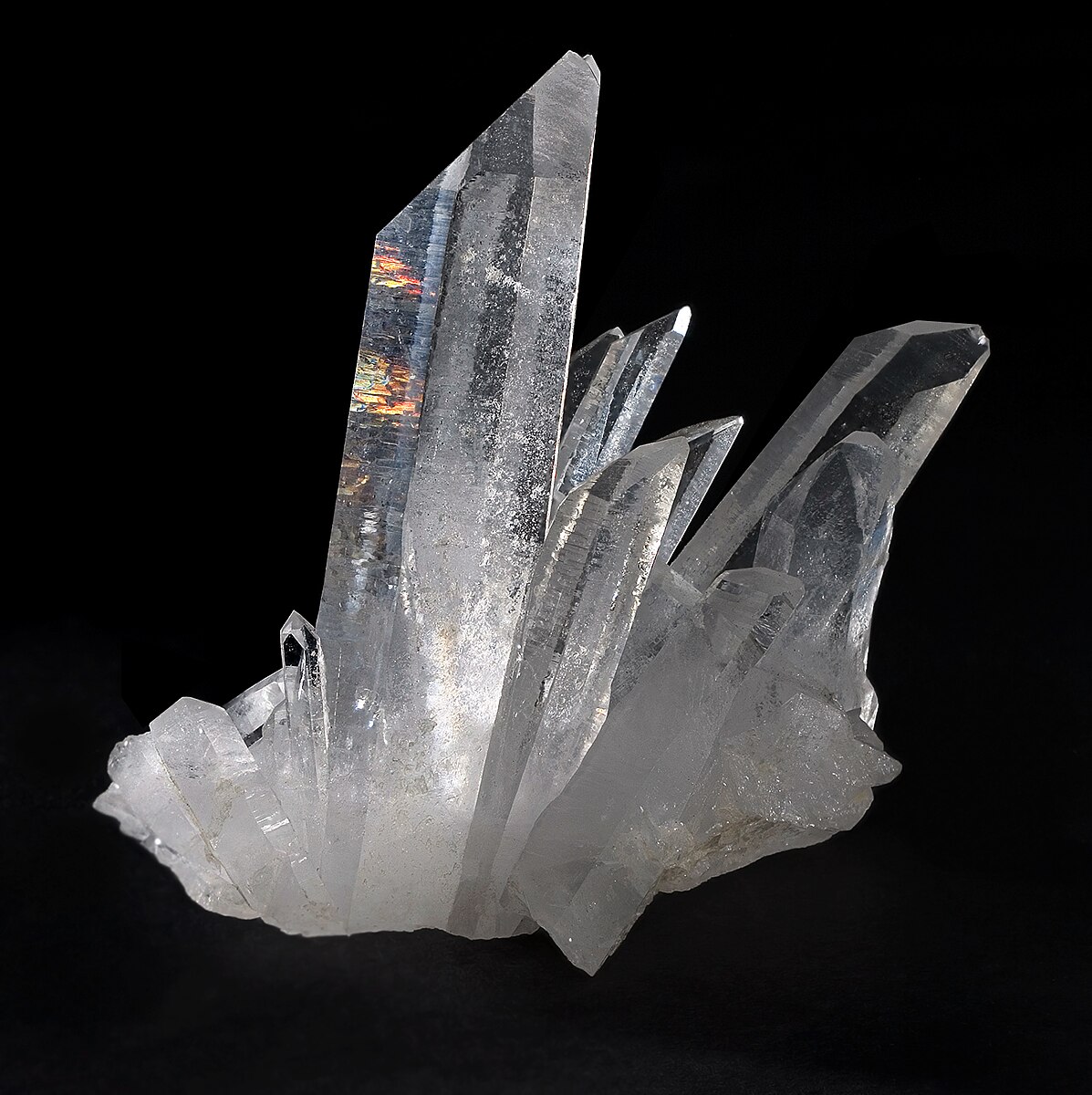
Quartz is a colorless, transparent, single-crystal subspecies, chemically composed of high-purity SiO₂. It has intact crystals and exhibits a distinct vitreous luster and piezoelectric effect. In nature, it typically occurs as clusters or individual crystals in hydrothermal veins or geodes. As a special form of quartz with both industrial and decorative value, high-quality quartz is an important material for making optical devices, resonators, lenses, and decorative crafts.
4. Amethyst:
A major variety of quartz, it exhibits its purple color due to trace amounts of iron and other coloring elements within the crystal, and its chemical properties are identical to quartz. Its color distribution is often uneven, and it is one of the most well-known gem-quality minerals in the quartz family. It is primarily used in jewelry, carved crafts, and collectibles; some high-quality crystals are also used to create specialized optical components.
5. Silicon dioxide:
Silicon dioxide (SiO₂) is a compound composed of silicon and oxygen. It is a chemical component of minerals such as quartz and crystal, and can also be obtained through chemical synthesis or biodeposition (e.g., diatomaceous earth). Based on its structure, it can be divided into crystalline (e.g., quartz, cristobalite) and amorphous (e.g., fused silica, silica gel). It is a fundamental material of modern high-tech industries; high-purity silicon dioxide (≥99.999%) is a core raw material for manufacturing semiconductor chips, photovoltaic silicon wafers, optical fibers, and high-end optical glass.
 中文
中文  English
  Español
  Português