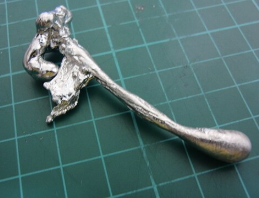
Sn
Sn
1、Tin Ore Sand
Ore particles containing tin, with the main mineral being cassiterite (SnO₂), often accompanied by impurities such as tungsten, bismuth, and molybdenum. Tin’s low melting point and good solderability make it widely used in welding in the electronics industry for manufacturing solder wires and bars, and in the food packaging industry for tinplate.
2、Tin Concentrate
A product obtained through beneficiation and enrichment of tin ore sand, with high tin content, serving as the main raw material for tin smelting. Smelted tin is used to produce various tin alloys, such as bronze (copper-tin alloy) for artistic sculptures and mechanical parts, and Babbitt metal (tin-based bearing alloy) for mechanical bearings.
3. Tin alloy:
Tin alloys are alloy materials made by adding elements such as lead, antimony, copper, and silver to tin as a base. Examples include solder, Babbitt metal, and tin bronze. They have properties such as low melting point, good wettability, wear resistance, and corrosion resistance. They are formulated through precision melting and are widely used in fields such as electronic welding, bearing lining, food packaging, and decoration.
4. Tin ingots:
Tin ingots are the primary metallic form obtained from tin concentrate or recycled tin through reduction smelting. They typically have a purity of 99.0% to 99.9% and contain small amounts of impurities such as lead, antimony, and bismuth. Tin ingots are the main commercial form of tin smelting and can be directly used in alloy preparation, tin plating of tinplate, and the manufacture of chemical products. They are also the raw material basis for refined tin.
5. Electrolytic tin:
Electrolytic tin is a high-purity tin product obtained through electrolytic refining from crude tin or tin anodes. Its purity is generally not less than 99.95%, and it has a smooth and dense surface. It has extremely low impurity content, excellent ductility and chemical stability, and represents the high-end refined form of tin. It is mainly used in high-end electronic solders, superconducting materials, photovoltaic coatings, and precision chemicals.
6. Tin scrap:
Tin scrap refers to tin-containing waste metals or industrial residues, mainly derived from tinplate, solder, tin alloys, and electroplating residues, with diverse tin content and forms. It is an important recycled tin resource; through recycling and smelting, it can be reused to produce tin ingots or alloys, helping to reduce reliance on primary tin ore mining and representing a key link in the circular economy of the tin industry.
 中文
中文  English
  Español
  Português